

UV germicidal lamps need to be equipped with specialized electronic ballasts, mainly due to the special requirements of their working principle and the significant advantages of electronic ballasts in performance and functionality. The specific reasons are as follows:
I. Working Principle of UV Germicidal Lamps and Core Functions of Ballasts
UV germicidal lamps (mostly low-pressure mercury lamps) generate ultraviolet radiation through mercury vapor discharge inside the tube. Their working process consists of two stages:
1.Start-up phase: An instantaneous high voltage is required to ionize the gas inside the tube, forming a discharge channel.
2. Stable operation phase: Current limitation is necessary to prevent lamp burnout from excessive current, while maintaining stable voltage and current output.
Core functions of ballasts:
• Provide start-up high voltage: Generate instantaneous high voltage during start-up to ionize the gas inside the tube and activate the lamp.
• Limit operating current: Prevent lamp damage from excessive current and ensure stable operation.
• Maintain stable output: Regulate voltage and current to ensure consistent UV radiation intensity, thereby sustaining germicidal effectiveness.
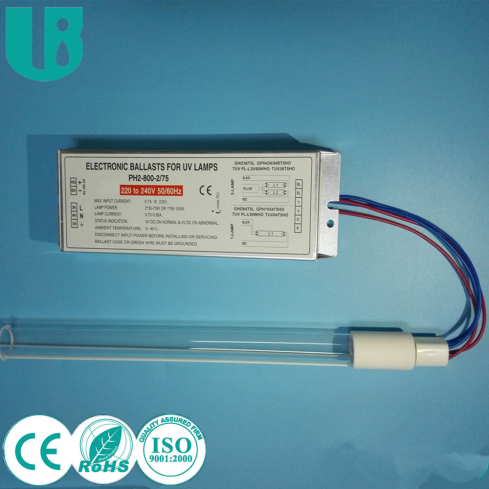
II. Advantages of Electronic Ballasts Over Inductive Ballasts
Traditional inductive ballasts can fulfill basic functions but suffer from drawbacks such as low power factor, poor low-voltage start-up performance, high energy consumption, large size, and excessive noise. In contrast, electronic ballasts convert mains frequency alternating current to high-frequency alternating current through high-frequency switching technology, offering the following distinct advantages:
1. Energy efficiency:
Low power consumption of the ballast itself, reducing lamp power consumption by approximately 20% with significant energy-saving effects.
High-frequency current enhances lamp luminous efficiency and minimizes energy waste.
2. Stable output and fast start-up:
High-frequency current eliminates lamp flicker, enables faster start-up, reduces current impact during ignition, and extends lamp lifespan.
Stable output current prevents reduced germicidal effectiveness caused by voltage fluctuations.
3. Diversified functions:
• Preheating function: Preheats lamp electrodes to reduce thermal shock during start-up and prolong lamp life.
• Protection functions: Equipped with abnormal condition protection, surge voltage/current protection, and temperature protection to prevent lamp damage from irregularities.
• Dimming and remote control: Some electronic ballasts support dimming to adjust UV intensity as needed; intelligent models also enable remote control for convenient management.
4. Strong adaptability:
Compatible with a wide voltage range (e.g., 110-240V), meeting usage requirements in different regions worldwide.
Customizable waterproof, dustproof, and corrosion-resistant models are available for special environments (e.g., humid areas, water treatment facilities) to ensure stable operation.
III. Compatibility Between Specialized Electronic Ballasts and UV Germicidal Lamps
UV germicidal lamps have high requirements for ballast compatibility. Specialized electronic ballasts ensure optimal performance through the following designs:
1. Power matching:
Ballast power must be strictly matched to lamp power to avoid failure to start (insufficient power) or shortened lamp life (excessive power).
For example, high-power UV germicidal lamps (120W, 150W, 320W, etc.) require specialized electronic ballasts to withstand the instantaneous high voltage and current during start-up.
2. Optimized start-up methods:
Adopt delayed start or soft-start technology to reduce current impact during ignition and protect the lamp.
For scenarios with frequent switching (e.g., public places, water treatment equipment), the delayed shutdown function prevents lamp damage from frequent on/off cycles.
3. Environmental adaptability:
Equipped with moisture-proof and waterproof features (e.g., IP20 protection rating) for humid or high-moisture environments to prevent internal component damage from dampness.
Temperature protection ensures stable operation in high or low-temperature conditions.
Post time:2025-12-19 17:13:51